
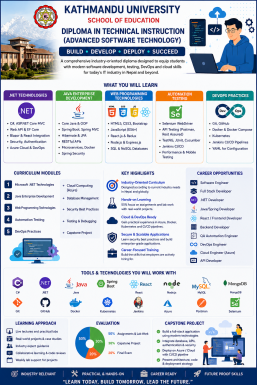
The Information Technology (IT) industry is changing faster than ever before. Artificial Intelligence (AI), Cloud Computing, DevOps, Automation Testing, Full-Stack Development, and Cybersecurity are becoming essential skills in software companies worldwide. In Nepal, companies are no longer looking for graduates who only know programming languages—they are looking for professionals who can design, develop, test, deploy, and maintain complete software systems.
Kathmandu University’s Diploma in Technical Instruction (Advanced Software Technology) has been designed to meet these modern industry requirements. The syllabus focuses on practical software engineering rather than only theoretical concepts, making it one of the most relevant IT programs for students, fresh graduates, and working professionals.
The Current IT Market in Nepal
The Nepalese IT sector has experienced remarkable growth over the past few years. Hundreds of software companies now provide services for clients in the United States, Australia, Europe, Japan, and the Middle East.
Popular companies recruit developers in:
- Full Stack Development
- Web Development
- Cloud Computing
- DevOps Engineering
- QA Automation
- Software Testing
- API Development
- Enterprise Software
- Banking Software
- FinTech
- Healthcare Applications
- Educational Technology
However, many graduates still struggle to find jobs because traditional university programs often emphasize theoretical programming instead of industry-ready practical skills.
This syllabus directly addresses that gap.
Complete Industry-Oriented Curriculum
Unlike traditional programming courses, this diploma covers the entire Software Development Life Cycle (SDLC).
Students learn:
- Software Design
- Programming
- Database Development
- API Development
- Testing
- Deployment
- Cloud Computing
- DevOps
- Project Management
Instead of producing only programmers, the program prepares students to become professional software engineers.
1. Microsoft .NET Technologies
One of the strongest components of the syllabus is Microsoft .NET Technologies.
Students learn:
- C#
- ASP.NET Core MVC
- Web API
- Entity Framework Core
- Blazor
- React Integration
- Azure Cloud
- Docker
- Authentication
- Security
- Unit Testing
The syllabus even includes deployment on Microsoft Azure using CI/CD pipelines, which is exactly how modern software companies work today.
Why this is valuable
Many banks, insurance companies, government projects, hospitals, and enterprise organizations in Nepal use Microsoft technologies.
Therefore, graduates become suitable for jobs such as:
- .NET Developer
- Backend Developer
- Full Stack Developer
- Azure Developer
- Enterprise Software Engineer
2. Modern Java Enterprise Development
Java continues to dominate enterprise software development globally.
This syllabus includes:
- Core Java
- Spring Boot
- Spring MVC
- Spring Security
- Hibernate
- REST API
- JWT Authentication
- Docker
- Kubernetes
- Microservices
- DevOps
Instead of teaching only Java syntax, students learn enterprise application architecture used by multinational software companies.
Career opportunities
Students can become:
- Java Developer
- Spring Boot Developer
- Backend Engineer
- Enterprise Application Developer
3. Complete Full Stack Web Development
Today’s companies rarely hire developers who only know HTML or PHP.
They prefer Full Stack Developers.
This course includes:
Frontend
- HTML5
- CSS3
- Bootstrap
- JavaScript ES6
- React.js
- Redux
Backend
- Node.js
- Express.js
- MongoDB
- MySQL
- JWT Authentication
- OAuth
Students build real-world applications instead of simple classroom projects.
This skill set matches the requirements of startups and software outsourcing companies in Nepal.
4. DevOps – The Future of Software Development
One of the biggest strengths of this diploma is the dedicated DevOps course.
Many universities still do not teach DevOps, despite it being a core requirement in modern software engineering.
Students learn:
- Git
- GitHub
- Docker
- Kubernetes
- Jenkins
- YAML
- CI/CD Pipelines
They also complete a capstone project implementing an end-to-end DevOps pipeline.
Why DevOps matters
Software companies now deploy applications multiple times per day. Manual deployment is no longer practical.
Organizations need engineers who understand:
- Continuous Integration
- Continuous Deployment
- Containerization
- Automation
- Cloud Deployment
These skills significantly improve employability.
5. Automation Testing
Testing is often overlooked in many academic programs, but this syllabus includes a dedicated Automation Testing subject.
Students learn:
- Selenium
- API Testing
- Postman
- REST Assured
- Jenkins
- Cucumber
- TestNG
- JUnit
- Performance Testing
- Mobile Testing
This prepares graduates for Software Quality Assurance (SQA) and QA Automation roles.
Growing demand
Many outsourcing companies in Nepal actively recruit QA Automation Engineers because automation improves software quality and reduces development costs.
6. Cloud Computing Integration
Cloud computing has become the standard for software deployment.
Students gain practical experience with:
- Microsoft Azure
- Docker
- Kubernetes
- Cloud Deployment
- CI/CD Pipelines
This gives them experience beyond local server deployment, aligning with global industry practices.
7. Real Project-Based Learning
One of the strongest aspects of this syllabus is the emphasis on capstone projects.
Students build complete applications such as:
- eCommerce Systems
- Blogging Platforms
- Enterprise Management Systems
- REST APIs
- Full Stack Applications
Projects include:
- Development
- Testing
- Deployment
- Documentation
- Presentation
These projects can become valuable additions to a student’s portfolio.
8. Equal Importance to Practical Learning
The evaluation system reflects industry priorities:
- Assignments and Lab Work – 50%
- Capstone Project – 30%
- Final Examination – 20%
This ensures that students are assessed primarily on practical skills rather than memorization.
9. Focus on Software Security
Modern software must be secure.
The syllabus covers:
- JWT Authentication
- OAuth
- Data Encryption
- API Security
- XSS Prevention
- CSRF Protection
- Authorization
- Role-Based Security
Security concepts are integrated throughout the development process rather than treated as a separate topic.
10. Alignment with Nepal’s IT Industry
This curriculum aligns well with the technologies commonly used by software companies in Nepal, including:
- C#
- Java
- Spring Boot
- React
- Node.js
- Git
- Docker
- Kubernetes
- Azure
- REST APIs
- Selenium
- Jenkins
These are among the most frequently requested skills in software engineering roles.
Who Should Join This Diploma?
This program is well suited for:
- BCA Students
- BSc CSIT Students
- BIT Students
- B.Tech Students
- Computer Engineering Students
- MCA Students
- Fresh Graduates
- Diploma Graduates
- Software Developers seeking to upskill
- QA Engineers
- IT Professionals looking to transition into modern software development
Career Opportunities After Completion
Graduates can pursue roles such as:
- Software Engineer
- Full Stack Developer
- .NET Developer
- Java Developer
- React Developer
- Node.js Developer
- Backend Developer
- Frontend Developer
- API Developer
- QA Automation Engineer
- DevOps Engineer
- Cloud Engineer
- Azure Developer
- Technical Consultant
- Freelance Software Developer
Strengths of the Syllabus
| Strength | Industry Value |
|---|---|
| Full Stack Development | High |
| Microsoft .NET | High |
| Java Enterprise Development | High |
| React.js | High |
| Node.js | High |
| Automation Testing | Very High |
| DevOps | Excellent |
| Cloud Computing | Excellent |
| Git & GitHub | Essential |
| Docker & Kubernetes | Excellent |
| API Development | Essential |
| Software Security | Excellent |
| Capstone Projects | Excellent |
| Practical Labs | Excellent |
Suggestions for Future Enhancement
While the syllabus is comprehensive, adding the following topics could make it even more future-ready:
- Artificial Intelligence (AI) integration for software development
- GitHub Copilot and AI-assisted coding tools
- Large Language Models (LLMs) and AI APIs
- Cybersecurity best practices aligned with the OWASP Top 10
- Serverless Computing (Azure Functions, AWS Lambda)
- Infrastructure as Code (Terraform)
- Agile Project Management (Scrum)
- Observability and Monitoring (Prometheus, Grafana)
- Modern frontend frameworks such as Next.js
- Cloud-native architecture and microservices design patterns
Conclusion
Kathmandu University’s Diploma in Technical Instruction (Advanced Software Technology) is a highly industry-oriented curriculum that addresses the needs of Nepal’s evolving IT sector. By combining modern programming languages, full-stack development, cloud computing, DevOps, automation testing, software security, and project-based learning, it equips students with practical skills that employers value.